Autor
The Breyeller Lakes – our “backyard nature reserve”
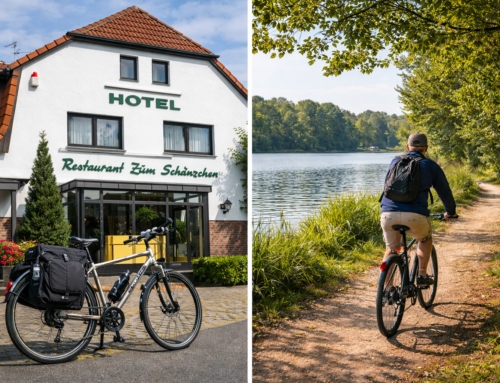
Closest to us are the Breyeller Lakes – the Upper and Lower Breyeller Lake. The short premium walking loop “Breyeller Seerunde” starts right at the car park by Zum Schänzchen. Officially it’s about 3.9 kilometres with barely 20 metres of elevation gain – practically flat, with no real climbs.
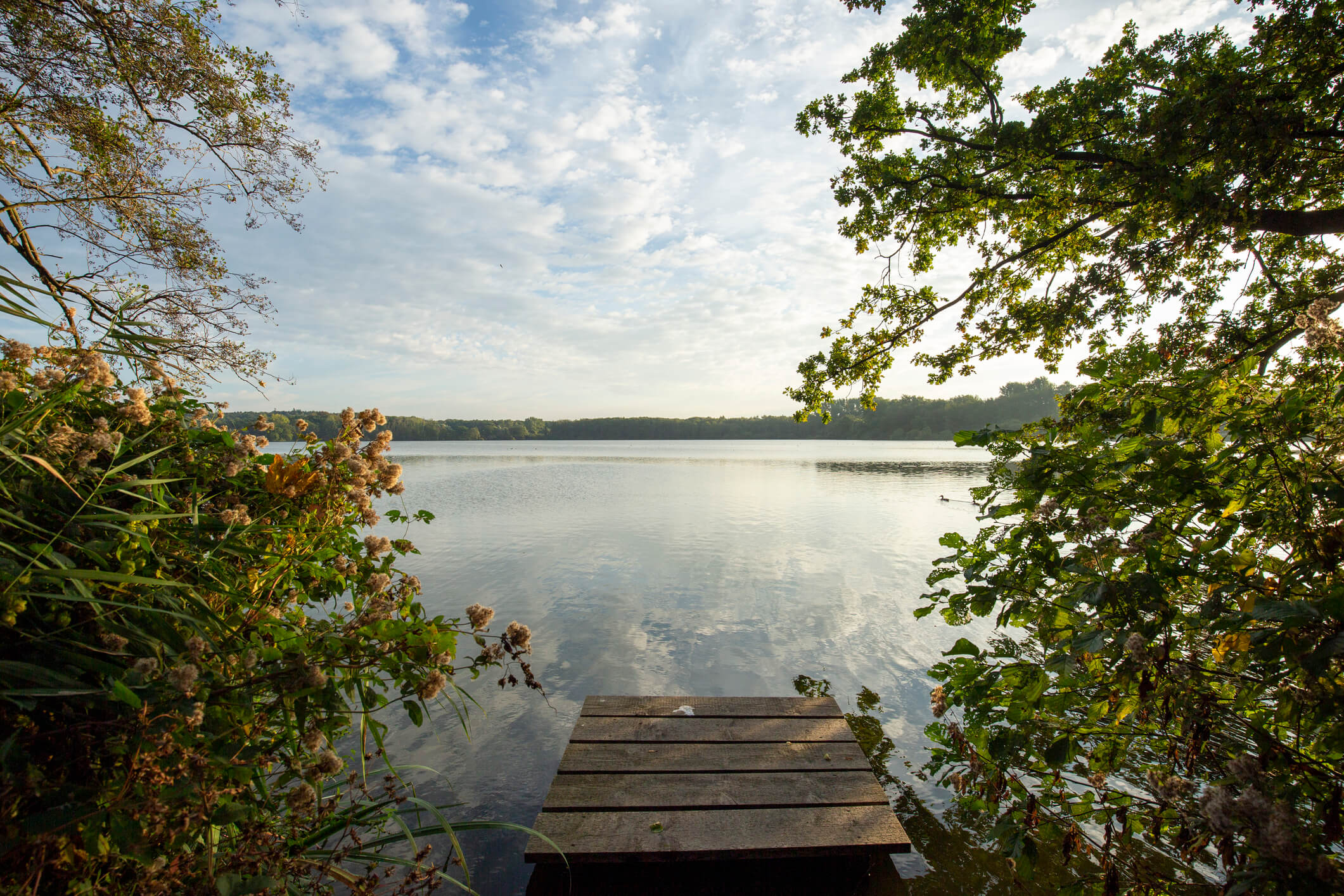
The route first leads through a small woodland area behind the hotel, then the view opens out onto the water of the Upper Breyeller Lake. Between trees and reeds, the water shimmers — depending on the season, with ducks, geese or gulls on it. Later you pass under the motorway bridge — from here the lake is called “Lower Breyeller Lake” — and along the embankment you get repeated open views across the landscape.
For guests, this is the easiest way to experience nature: no car, no drive, just step outside and set off. In the morning before breakfast, in the evening after dinner, with or without a dog — these lakes are like our “outdoor living room.”
De Witt Lake – old railway line, birdlife and wide-open views
A few minutes by car away is De Witt Lake, also part of the nature park. Here several things come together: an old railway line that is now used as a wide cycling and walking path, natural shoreline areas, and surprisingly lively birdlife.
From the former railway embankment looking out over the water, you’ll usually see coots and great crested grebes, and often cormorants too. With a little patience and luck, you may hear reed warblers and other typical “Lower Rhine voices” in the reed beds.
A circular path of just under four kilometres runs around the lake and is officially described as a walk. Along the way the mood changes: one section with views across the open lake, then a stretch through woodland, then pollarded willows, a nature conservation farm, and water again.
What we like about De Witt Lake: it feels like you’re far out in nature, without the journey being complicated. And if you don’t want to head straight back after your loop, you’ll find places to stop such as the café/restaurant by the lake or PURiNO on the other side — perfect for a coffee or something to eat.
Example walk to Windmühlenbruch
Krickenbeck Lakes & the Hinsbeck Heights — a spectacular natural panorama
When we talk about “really getting out into nature,” we often mean the Krickenbeck Lakes. Four lakes — Hinsbecker Bruch, Glabbacher Bruch, Poelvenn and Schrolik — lie there like a chain in what was once moorland. They were created through peat extraction and the diversion of the Nette River; today they are a nature reserve and part of the nature experience area.
A particularly beautiful view opens up from the embankment between Glabbacher Bruch and Hinsbecker Bruch: water to the left and right, reeds and old trees in between, and oak and beech woodland in the background. From the fire watchtower on the Hinsbeck Heights, you can see the lake landscape from above — in summer, some areas are covered with water lilies.
Around the lakes, the Biological Station has signposted several circular routes that lead through woodland, along meadows and repeatedly back to the shore. The routes vary in length, but all are well marked and designed so that you will regularly come across benches, viewpoints or information boards.
If you have half a day or a full day, you can combine a lake loop with a detour to the information centre or a stop at Leuther Mühle — an old mill that is now used as a restaurant.
Premium hiking trail “NetteSeen” — one big loop through a landscape shaped by water
If you want to experience more than just a snapshot of the nature park, take on the premium hiking trail “NetteSeen.” It is one of nine award-winning premium trails in the Wasser.Wander.Welt and covers around 13 kilometres through a landscape strongly shaped by water — alternating between lakes, meadows, woodland and small heathland areas.
Parts of the route follow sections you may already know from De Witt Lake or the Krickenbeck Lakes, but it links them into one larger loop. For a holiday day or a long weekend, it’s like a “compressed nature park”: you spend a long time on near-natural paths, enjoy plenty of quiet stretches, and in between there are views over the water or viewpoints.
Why this nature here matters so much
Many guests notice after a day or two how good this mix of water, woodland and quiet paths feels. It’s not a dramatic high-mountain landscape, but a calm, flat area that you discover step by step. That is precisely why it has been designated a nature park: the combination of old moorland, lakes, river courses, wet woodland and meadows provides habitat for many rare species — and gives people space to breathe.
When you’re back at Zum Schänzchen in the evening after a loop around the Breyeller Lakes or a day at the Krickenbeck Lakes, it often feels as if you’ve been much farther away than the map suggests. That’s probably the greatest strength of this area — you can get out into nature quickly and return just as easily.
Questions? We’ll gladly point you to “the right lake”
This guide can only give an impression. We prefer to work out what suits you best in a quick conversation:
Do you have just an hour, or a whole day? Are children or a dog coming along? Would you prefer quiet paths, or is a place to stop for food and drink important to you?
Just tell us briefly what you’re looking for — and we’ll point you to the right lake.
Related Posts